
Gender-affirming therapy is a specific form of mental healthcare that seeks to honor and celebrate a person’s gender rather than “fix” it.
While it’s often recommended for people as they go through gender transition, people in all stages of their gender journey can benefit from gender-affirming therapy.
Similar to gender-affirming healthcare (which focuses more on the medical aspects of gender expression and transition), gender-affirming therapy is designed to improve the health and well-being for transgender and gender-noncomforming people.
Gender-affirming therapy is designed to celebrate and support people whose gender identity differs from the one they were assigned at birth. It is not designed to “fix” a person’s gender. It creates a safe space for people who are transgender, non-binary, fluid, or questioning their gender identity to receive support as they navigate their journey.
Similar to gender-affirming healthcare (which focuses more on the medical aspects of gender expression and transition), gender-affirming therapy is designed to improve the health and well-being of people with diverse gender identities and expressions.
Find your match
Take the first step toward better mental health.
What is gender identity?
In the past, most people understood gender as a binary concept defining only two genders – male and female.
But we now know that gender is a spectrum and people can express their gender identity in many different ways. People can identify as men, women, non-binary, none of these, a combination of these, fluid, and more. Each person gets to decide the term that best represents their identity and these terms can evolve over time.
Dig deeper:
By some measures, our society has begun to broaden our understanding of gender in recent decades. But many transgender and gender-nonconforming people continue to face challenges in their daily lives due to the stigma that persists around gender diversity.
Research shows that transgender people are more likely to be diagnosed with anxiety and depression and transgender youth are especially vulnerable to suicidality.*
Being transgender doesn’t make a person inherently more likely to develop a mental health condition or engage in self-harm. Rather, these risks are increased among trans people due to the bullying, mistreatment, and ostracization that they often face.
*A note on safety: Members of the LGBTQ+ community are at an increased risk of suicidality. If you’re having thoughts of harming yourself, don’t hesitate to ask for help. You can contact the National Suicide and Crisis Lifeline by dialing 988 from any phone. Their counselors will provide confidential support and resources to help keep you safe. You can also contact The Trevor Project anytime, 24/7 for LGBTQ-affirming crisis and peer support.
What is gender-affirming therapy?
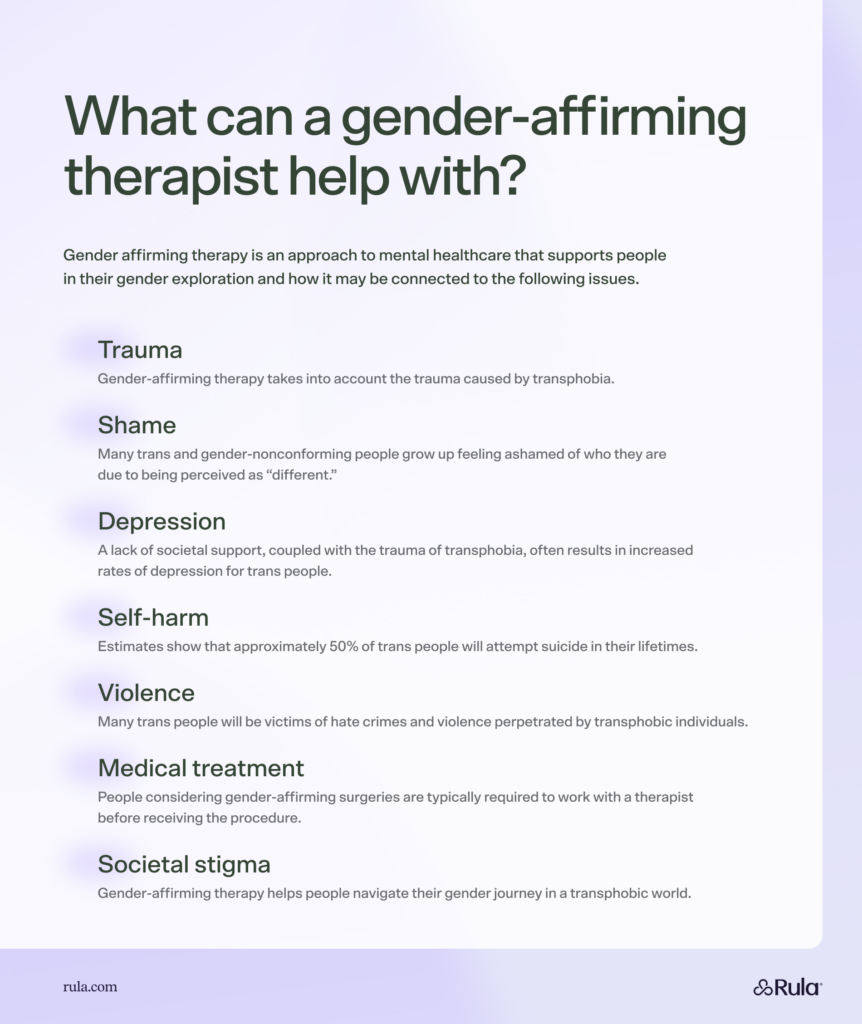
Gender-affirming therapy is a specific form of mental healthcare that seeks to honor a person’s gender. According to the American Psychiatric Association, gender-affirming therapy addresses the following issues alongside a person’s gender exploration.
Trauma: Gender-affirming therapy must take into account the trauma caused by transphobia.
Shame: Many trans and gender-nonconforming people grow up feeling ashamed of who they are due to being perceived as “different.”
Depression: A lack of societal support, coupled with the trauma of transphobia, often results in increased rates of depression for trans people.
Self-harm: Estimates show that approximately 50% of trans people will attempt suicide in their lifetimes.
Violence: Many trans people will be victims of hate crimes and violence perpetrated by transphobic individuals.
Medical treatment: People considering gender-affirming surgeries are typically required to work with a therapist before receiving the procedure.
Societal stigma: Gender-affirming therapy helps people navigate their gender journey in a transphobic world.
As you begin your search for a qualified provider, be sure to pay attention to their credentials. Don’t be afraid to ask questions like “How much of your current caseload is made up of transgender people?” or “What type of training do you have in working with trans people?”
A qualified provider will welcome these sorts of questions and will be happy to talk to you about their skills and experience in supporting LGBTQ+ people.
If you feel uncomfortable with a therapist for any reason, know that you can always work with someone else who might be a better fit.
Dig deeper:
Who can benefit from gender-affirming therapy?
Gender-affirming therapy is commonly recommended for people as they transition. While more research is needed to document the benefits of gender-affirming therapy, you can access this form of support at any stage of your gender journey (whether you’re just beginning to question your gender or if you’ve been fully transitioned for some time).
Gender-affirming therapy can also be a great resource for allies, supportive friends, and family. It can help you identify your biases in a safe space and learn how best to support the trans and gender-nonconforming people in your life.
The care you need, when you need it
Learn how Rula can support your mental health journey
How therapy can support you on your gender journey
Therapy can provide a host of mental health benefits to transgender and gender-nonconforming people, including:
Improved self-esteem
Reduced anxiety and depression
Enhanced coping mechanisms for dealing with transphobia and other social challenges
Reduced gender dysphoria (a feeling of unease that occurs when someone feels a disconnect between their gender identity and the gender they were assigned at birth)
Strengthened relationships with supportive loved ones
Support before and during transitioning
Reduced risk of self-harm and suicide
Dig deeper:
What if there aren’t any gender-affirming therapists in my area?
Despite growing awareness of the need for gender-affirming therapy, it can still be difficult to find a qualified gender-affirming therapist, especially in rural areas. Issues with affordability often exacerbate the provider shortage and many communities lack safe, confidential spaces to conduct gender-affirming care.
If you or someone you care about is having trouble finding a qualified gender-affirming therapist in your community, know that you’re not alone and that other options are available.
With online therapy, you can meet with a qualified, inclusive therapist online from the comfort of your home (or wherever you’re most comfortable).
Find care with Rula
Gender-affirming therapy honors and supports people whose gender identity differs from the one they were assigned at birth. It’s often used to help people going through gender transition, but can be a powerful tool at any stage of your gender journey. With the support of a qualified and compassionate provider, you can learn to improve self-esteem, reduce gender dysphoria, and feel more confident navigating life in a way that feels right for you.
At Rula, we’re here to help you feel better. Rula makes it easy to find a licensed therapist or psychiatric provider who takes your insurance. That way, you don’t have to choose between great care and a price you can afford.
Rula patients pay about $15 per session with insurance, and 93% say they feel better after getting care through Rula. We have 21,000+ providers, and appointments are available as soon as tomorrow. We’re here to help you take the next step — wherever you are in your mental health journey.
Find gender-affirming therapy near you
New York – Texas – California – Georgia – Illinois – Hawaii – Indiana – Virginia – North Carolina – Pennsylvania – Find your city

Liz Talago
Liz Talago, M.ed. is a mental health professional turned content writer and strategist based in the Detroit metro area. As an independent consultant for mental health organizations, Liz creates meaningful connections between brands and their audiences through strategic storytelling. Liz is known for championing diverse perspectives within the mental health industry and translating bold ideas into inspiring, affirming digital experiences.
In her free time, you can find her hiking with her two German Shepherds, puttering around her dahlia garden, or spending time with her family.

Nick Frye, MS, LCPC
Nick Frye, MS, LCPC holds a Master’s degree in Counseling Psychology from Loyola University Maryland and is a Licensed Clinical Professional Counselor (LCPC) in Maryland. With experience as a substance use disorder counselor and a private practice therapist, he has worked with diverse populations, specializing in depression, anxiety, life transitions, and grief. Passionate about mental health, Nick transitioned from direct patient care to education and mentorship to support both early-career and seasoned professionals in their growth and development as clinicians.
Rula’s editorial process
Rula’s editorial team is on a mission to make science-backed mental health insights accessible and practical for every person seeking to better understand or improve mental wellness.
Members of Rula’s clinical leadership team and other expert providers contribute to all published content, offering guidance on themes and insights based on their firsthand experience in the field. Every piece of content is thoroughly reviewed by a clinician before publishing.