

Women in Las Vegas, NV, Chicago, IL, and Miami, FL, are the most burdened by the invisible load.
81% of women frequently feel overwhelmed by everything they have to keep track of for their family.
Women say keeping track of everyone's schedules and medical and dental appointments are their most common parts of the invisible load.
52% of women say their partner isn't fully aware of the invisible load they bear.
67% of women sacrifice their alone time because of everything they manage for their household.
Throughout history, women have been viewed as homemakers who take care of the household needs, from cleaning and cooking to tracking schedules and tending to children. While this remains true for many women in modern times, the main difference is that “homemaker” is no longer the only job title.
Managing a daily grind at work, then coming home to care for a family, all while maintaining time for yourself is a very tall task. At Rula, we work closely with mental health experts to help people get the help they need. That’s why we wanted to dive into the “invisible load” women all across America are bearing.
To do this, we surveyed mothers who live with a partner in more than 30 major U.S. cities. We asked a variety of questions about the tasks in their household and who, between them and their partner, are typically responsible. We also asked how this load weighs on them, what sacrifices they make supporting these responsibilities, and how aware their partner is of this “invisible load.”
We then awarded points to responses that represented this and calculated an invisible load index on a scale of 0 to 100. Read on to learn where women are carrying the most responsibility on their shoulders alone.
Cities putting the most pressure on women at home
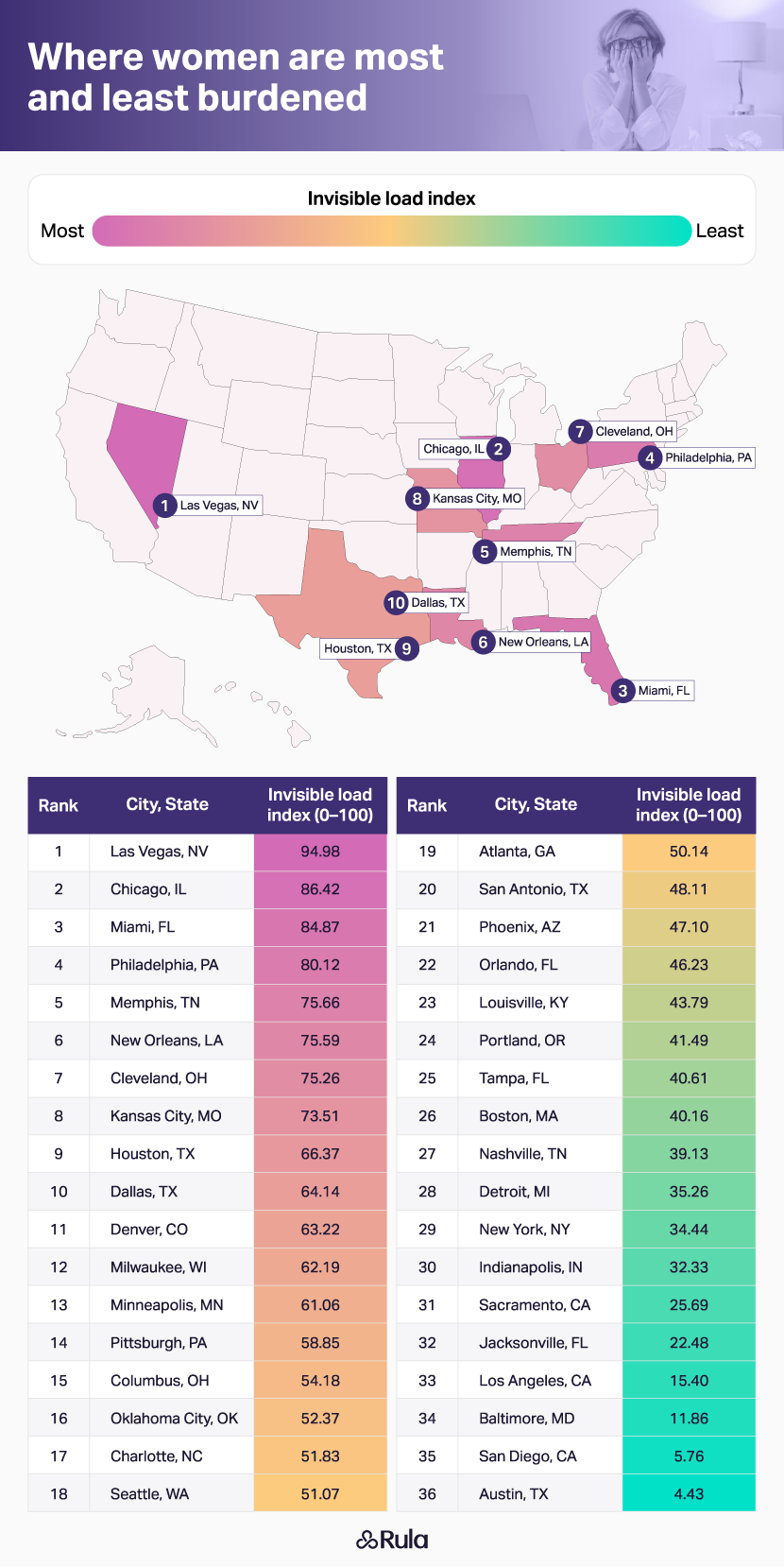 Invisible loads are carried all throughout the U.S., but we found the burden is heavier in some parts of the country. Leading the way with an invisible load index of 94.98 out of 100 is Las Vegas, NV. Women in Las Vegas are the most likely to be responsible for bedtime routines and medical and dental appointments for their household.
Coming in second place is Chicago, IL, with an index of 86.42 out of 100. Morning routines, cooking and meal prep, laundry, cleaning, and restocking household supplies are the most common tasks women in Chicago are responsible for.
Miami, FL, is up next claiming third place for the heaviest invisible load (84.87). In Miami, women are most likely to be responsible for organizing and decluttering their home, as well as handling paperwork and important documents. Rounding out the top five are Philadelphia, PA, (80.12) and Memphis, TN, (75.66), which rank fourth and fifth, respectively.
Overall, 81% of women frequently feel overwhelmed by everything they have to keep track of. In some cases, women take on these duties because others consider them to be “better at” household planning, organizing, or remembering things, which three in four women say they have been told. Sometimes these efforts can even go unnoticed as 52% of women say their partner isn’t fully aware of the invisible load they bear.
Top responsibilities and sacrifices made
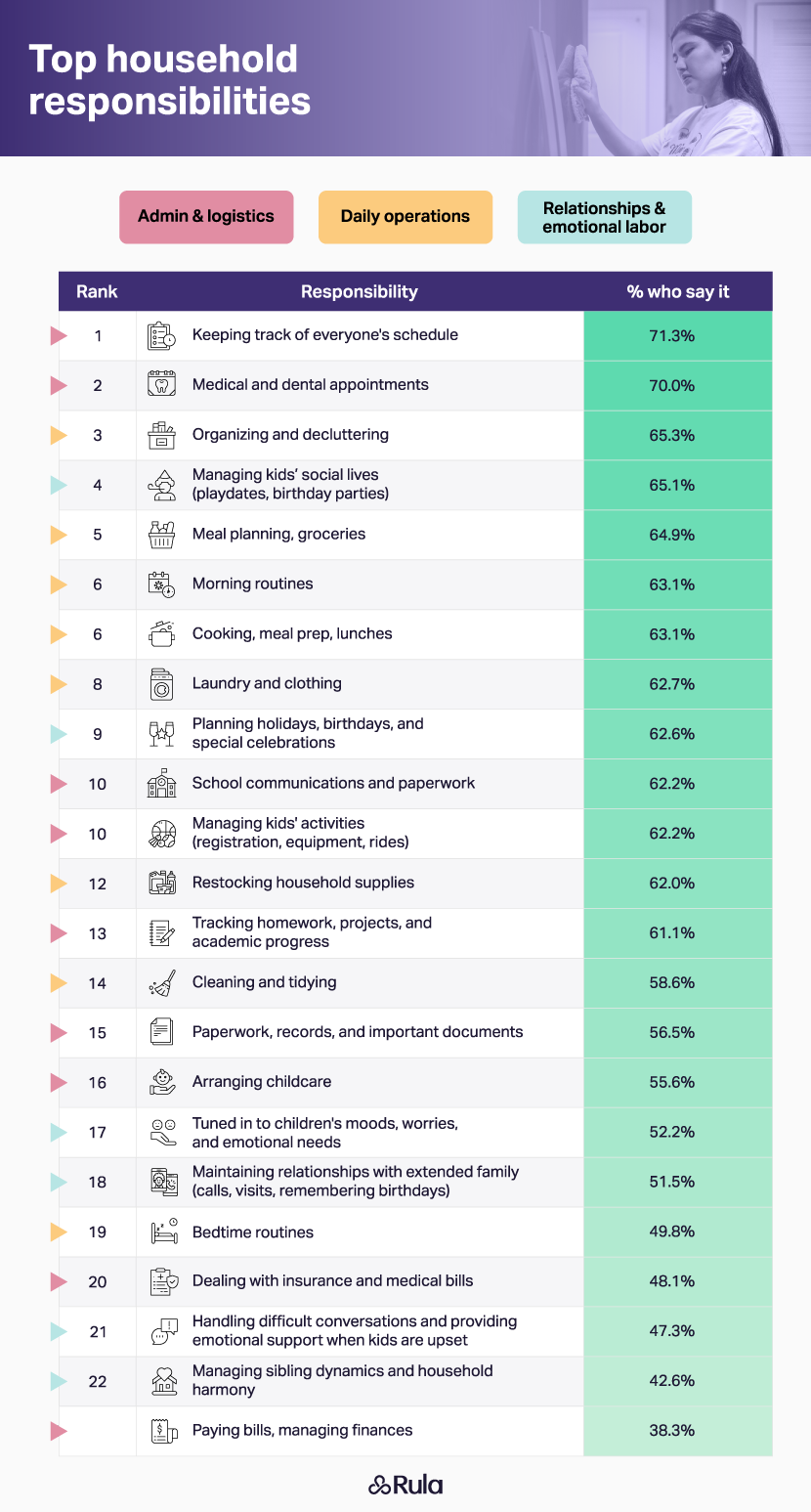 After learning where the invisible load pressure is felt most, we wanted to gain insight into the responsibilities weighing on women’s shoulders. Up first, as the most common task women say they are responsible for in their homes, is keeping track of everyone's schedule as 71.3% of women report it.
Handling medical and dental appointments is next up as 70.0% of women say they are regularly responsible. Coming in third place is organizing and decluttering within the home as 65.3% of women say they handle this task.
As part of the relationships and emotional labor tasks mothers are responsible for, managing kids’ social lives is the most common as 65.1% of respondents report it. This includes everything from scheduling playdates to taking kids to birthday parties.
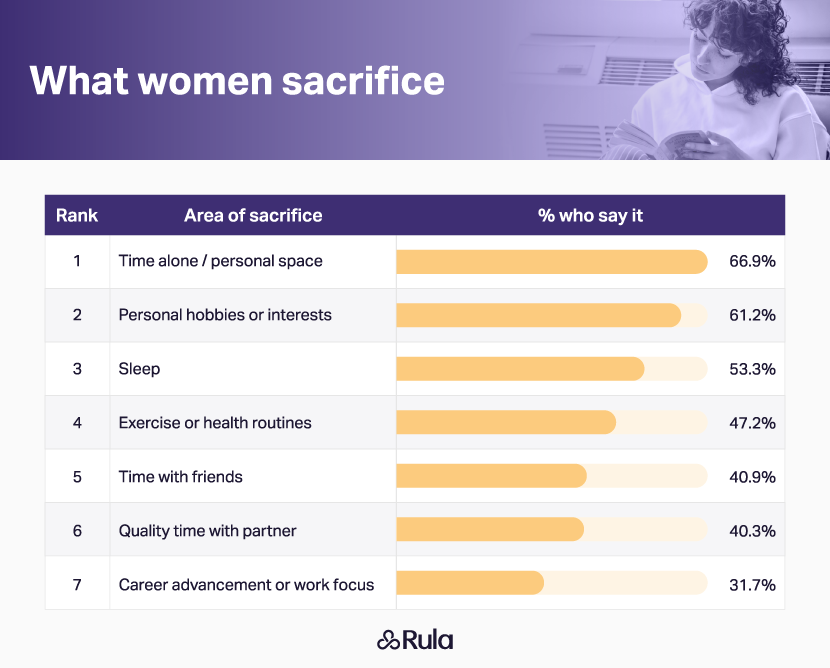 With so many tasks and so little time, it’s understandable that many women report making sacrifices for their family. Leading the way as the most common sacrifice is alone time and personal space, as 66.9% of women report it.
Up next is personal hobbies and interests, which 61.2% of women say they sacrifice as part of bearing the invisible load. Sleep is the third most common sacrifice as more than half of mothers across the country (53.3%) say they spend less time in bed due to their tasks.
Alleviate your mental load with Rula
Whether you work part-time, full-time, or not at all, the invisible load you carry can slowly start to chip away at your mental health. As the main supporter of your household, it’s not the dishes in the sink, soccer practice for your child, or even the groceries that are most important, it’s your mental wellbeing.
At Rula, we connect people with mental health experts that are tailored specifically to their needs. Through online therapy sessions, you’re able to meet anywhere on a schedule that works best for you. Get started today by filling out a couple of questions regarding your insurance and the type of care you are looking for and then schedule your first session as early as the next day.
Methodology
In this study, we set out to learn where women are burdened most by the invisible load of their household. To do this, we surveyed women in major cities who live with a partner and kids. We asked a variety of questions including who, between them and their partner, is typically responsible for household tasks, how often they are overwhelmed by their responsibilities, how aware their partner is of the invisible load they bear, and more.
We then awarded points to responses that represented sole responsibility for tasks, sacrifices being made for the sake of caring for their household, and feeling overwhelmed by these responsibilities. We then calculated an invisible load index by city and adjusted scores on a scale of 0 to 100, with 100 representing the most burdened.
To take into consideration the different work status dynamics among couples, we applied weights to individuals' scores. The highest weight (1.5) went to women who work full-time, while their partner doesn't work at all. This is followed by women who work full time while their partner works part-time (1.3) and women who work part-time while their partner doesn't work (1.2).
For women who work full-time with a full-time partner, women and their partner both working part-time, and women and men who both don't work the weight was 1. Women who work part-time with a full-time working partner received a .85 weight, women who don't work while their partner works part-time received a .75 weight, while women who don't work with a partner who works full-time received a .7 weight.

Rula Health
Rula’s editorial process
Rula’s editorial team is on a mission to make science-backed mental health insights accessible and practical for every person seeking to better understand or improve mental wellness.
Members of Rula’s clinical leadership team and other expert providers contribute to all published content, offering guidance on themes and insights based on their firsthand experience in the field. Every piece of content is thoroughly reviewed by a clinician before publishing.