
Find your therapist, covered by insurance


Our promise
A higher standard for care

Yvette D. Wilhite
LMFT

Kaitlin Olson
LMFT

Luke Thomas
LCSW

Gigi Natacia Jones
LMHC

Brenda Barzee Franson
NP

Alexa Bustamante
LPCC
Benefits of child therapy


Develop resilience and coping strategies
Diagnose mental health conditions
Improve communication skills
Connect thoughts and feelings
Improve self confidence
Strengthen family dynamics
How it works
Your journey to mental well-being gets easier from here
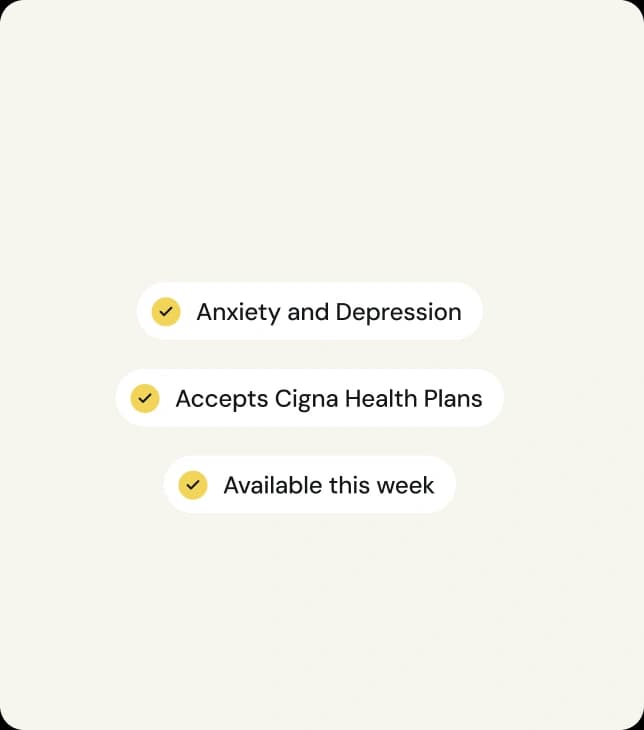
Tell us what's important
We’ll use your preferences and insurance information to find providers who fit your needs.

Explore your matches
Browse the profiles of licensed, in-network providers who match your preferences.
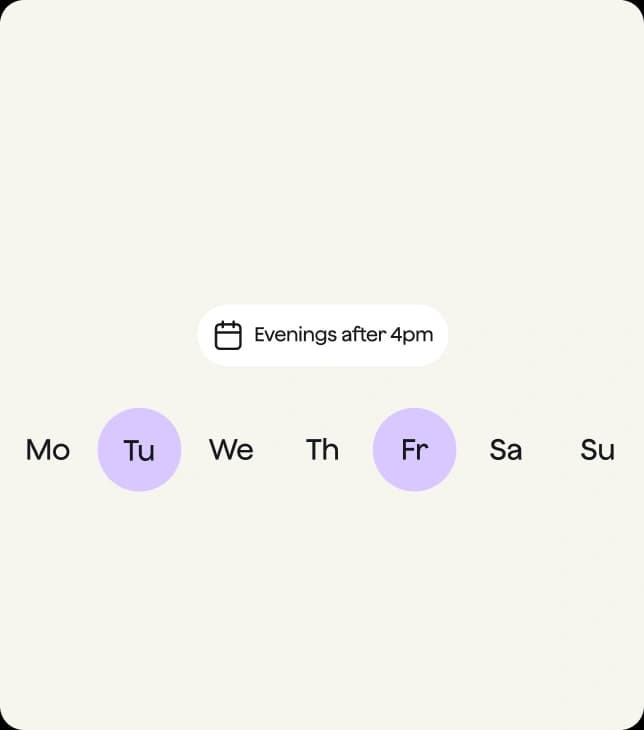
Schedule your visit
Choose your preferred time and meet with your provider as soon as tomorrow.

Join your session
Connect with your provider over live video from wherever you feel comfortable.
Types of child therapy
Child-Centered Play Therapy
Play therapy is a research-backed method that helps children communicate the thoughts and feelings they may not yet have the vocabulary to describe.
Cognitive Behavioral Therapy (CBT)
Cognitive behavioral therapy is a type of talk therapy that focuses on the connection between your child’s behaviors, thoughts and feelings.
Family therapy
Strengthen bonds, improve communication skills, and reduce conflict with your child through the professional expertise of a trained family therapist.


Millions of successful sessions and counting
Easy to access. More choices for therapy. Our therapist was a great fit for my daughter. Despite it being virtual only, my 9 year old daughter loved it.
Rula patient
We love meeting our therapist at a convenient time online. She is super knowledgeable, friendly, and helpful.
Rula patient
Our therapist listens compassionately and guides my 12 year old son to healthy thinking and healthy behavioral responses.
Rula patient
Our insurance connected us with Rula and the experience has been amazing. We could not be more grateful and appreciative to my son’s therapist.
Rula patient
Child & teen therapy

Starting therapy
There’s no right or wrong reason to start therapy. Whether your child is seeking help navigating a life transition or managing symptoms of anxiety or depression, therapy is an effective treatment for many types of concerns – all they need is an open mind and a general sense of what you’d like to explore with a therapist. Still unsure? Head to our blog to learn more.
Absolutely. Rula’s network of 20,000+ licensed therapists specializing in over 180 clinical specialties and modalities and representing a diverse range of ethnicities, identities, cultures, and faiths – making it easier to find the care they need. Once you provide us with some basic information, we’ll generate a curated list of in-network therapists who are licensed in your state and accepting new patients. From there, you can filter based on your child's needs and explore individual biographies until you find a match. Ready to get started? Click here.
Rula specializes in online therapy – giving you and your child the flexibility to meet with your therapist from wherever your family is most comfortable. We’ll send you appointment reminders containing a secure link to your scheduled Zoom session before your session.
Understanding costs
Yes! Therapists on the Rula platform are in-network with most major insurance plans. Rula patients typically pay $15 per session, although your individual cost may vary based on your insurance benefits and deductible. We’ll work with your insurance to confirm your estimated per session cost before your first appointment. Ready to get started? Click here to browse available therapists who accept your insurance.
No, Rula does not charge any fees. You’re only responsible for any applicable out-of-pocket expenses determined by your insurance – in other words, if your plan requires a $20 copay, that’s the most you would pay.
While Rula is in-network with most major insurance plans, we understand that not everyone is covered by insurance. Rula offers a cash rate of $150/session for individual therapy and $165/session for families or couples.
You can also use your HSA (Health Savings Account) or FSA (Flexible Savings Account) to cover out-of-pocket expenses.


© 2026 Rula Health. All rights reserved.