
A person with borderline personality disorder (BPD) may have difficulty maintaining stable, healthy relationships.
Despite certain misconceptions people living with BPD can be loving, dedicated partners. They’re often acutely aware of how their condition affects others and want to seek treatment to improve their relationships.
While BPD can have its challenges, there are ways to support your partner and strengthen your own mental health.
Borderline personality disorder (BPD) is a mental health condition characterized by severe and sudden mood swings, self-destructive behavior, and a deep fear of abandonment. Left untreated, these emotional and behavioral challenges can make it difficult for people with BPD to have stable relationships.
But unlike some of the common myths about BPD, people living with this condition can make loving and supportive partners. So if you’re dating someone with BPD, it’s normal to feel confused, overwhelmed, or unsure at times. And it’s also true that with understanding, support, and the right tools, healthy and supportive relationship dynamics are possible.
Understanding borderline personality disorder (BPD)
According to the National Alliance on Mental Illness (NAMI), BPD affects about 1.4% of the adult population in the U.S. And over 75% of people diagnosed with the condition are women. Some of the most common symptoms of BPD your partner may exhibit include:
Fear of abandonment: Your partner frequently worries about being left alone, even when there is no concrete reason to feel this way.
Unstable relationships: Your partner’s relationships tend to be tumultuous and intense. One moment, they idealize someone. Next, they perceive that person as terrible.
Changing self-image: Your partner’s perception of themselves and their self-worth constantly fluctuates. One day, they may feel confident, while the next, they may experience self-disgust.
Impulsive behaviors: Your partner engages in actions without considering the potential consequences, which can harm either themselves or others. Examples include overspending, engaging in risky sexual behavior, speeding, or gambling.
Self-harm: At times, your partner contemplates self-harm, or they actually engage in self-destructive behaviors, such as cutting or attempting suicide.*
Mood swings: Your partner’s emotional states can shift rapidly, changing from happiness and joy to devastation and depression within a short time frame.
Chronic emptiness: Regardless of their efforts or experience, your partner constantly feels a persistent sense of inner emptiness.
Intense anger: Your partner frequently experiences anger, often over trivial matters, and has a short temper.
Suspicion of others: Your partner struggles to trust people and frequently experiences feelings of paranoia, particularly under stress.
*If you or a loved one is experiencing suicidal thoughts or thoughts about harming themself or others, please call or text 988 on any phone for the Suicide & Crisis lifeline, contact a local crisis line, or head to the emergency room immediately. Any of these resources will ensure that the person in crisis receives support right away. For more information on getting help, go to 988lifeline.org
If experiencing a life-threatening emergency or you need immediate help, please call 911.
Find your match
Take the first step toward better mental health.
Misconceptions about dating someone with BPD
BPD is undoubtedly a challenging condition to live with. But there are some common myths and misconceptions surrounding BPD to be aware of if you’re dating someone with this condition.
Sometimes, people think that people living with BPD are incapable of being a loving partner. But that couldn’t be further from the truth and these ideas contribute to the stigma around BPD that can make it more difficult for a person to seek help.
Most people living with BPD are acutely aware of how their condition affects their lives and their partners, and don’t consciously want to engage in harmful or dangerous behaviors. Despite the difficulties caused by their condition, it’s possible that your partner may want to gain control of their symptoms so they can improve their well-being and build a healthier connection with you.
Challenges and rewards of dating someone with BPD
Dating someone with BPD can be intense and confusing at times. If you’re dating someone with BPD, you may feel the toll it can take on a relationship. Mood shifts, fear of abandonment, and emotional reactivity can lead to frequent conflict or instability. At times, your partner’s symptoms may result in behaviors that are painful for you to experience.
At the same time, there can be meaningful rewards. Research suggests that people with BPD often have high emotional sensitivity, creativity, and intellectual curiosity. Being in a relationship with someone with BPD can include deep connection, passion, and moments of genuine closeness that feel rare or profound.
These strengths don’t erase how hard it can feel to be in a relationship with someone with BPD. But recognizing both the challenges and the rewards can help you approach the relationship with clearer expectations, compassion, and the resilience needed to navigate difficult moments.
The care you need, when you need it
Learn how Rula can support your mental health journey
Building the foundations of a strong relationship
Just like in other relationships, it’s important to build a strong foundation in a relationship when one partner has BPD or another mental health concern. Throughout the course of your relationship, practice making time for open, honest dialogue about how BPD is affecting your connection. These conversations are usually best held at a time when both partners are feeling calm as it’s harder to problem-solve when emotions are flaring. Keep in mind that this conversation shouldn’t be a one-time affair. You’ll both need to commit to fostering open communication and practicing active listening with one another.
As you learn more about your partner’s experience of BPD, be sure to offer validation and empathy. Living with BPD can be a painful, stigmatized experience. So try to demonstrate compassion for what your partner has lived through. At the same time, be sure to practice setting healthy boundaries and prioritizing self-care. The more both partners can do to take care of their own individual mental health, the stronger your relationship will be.
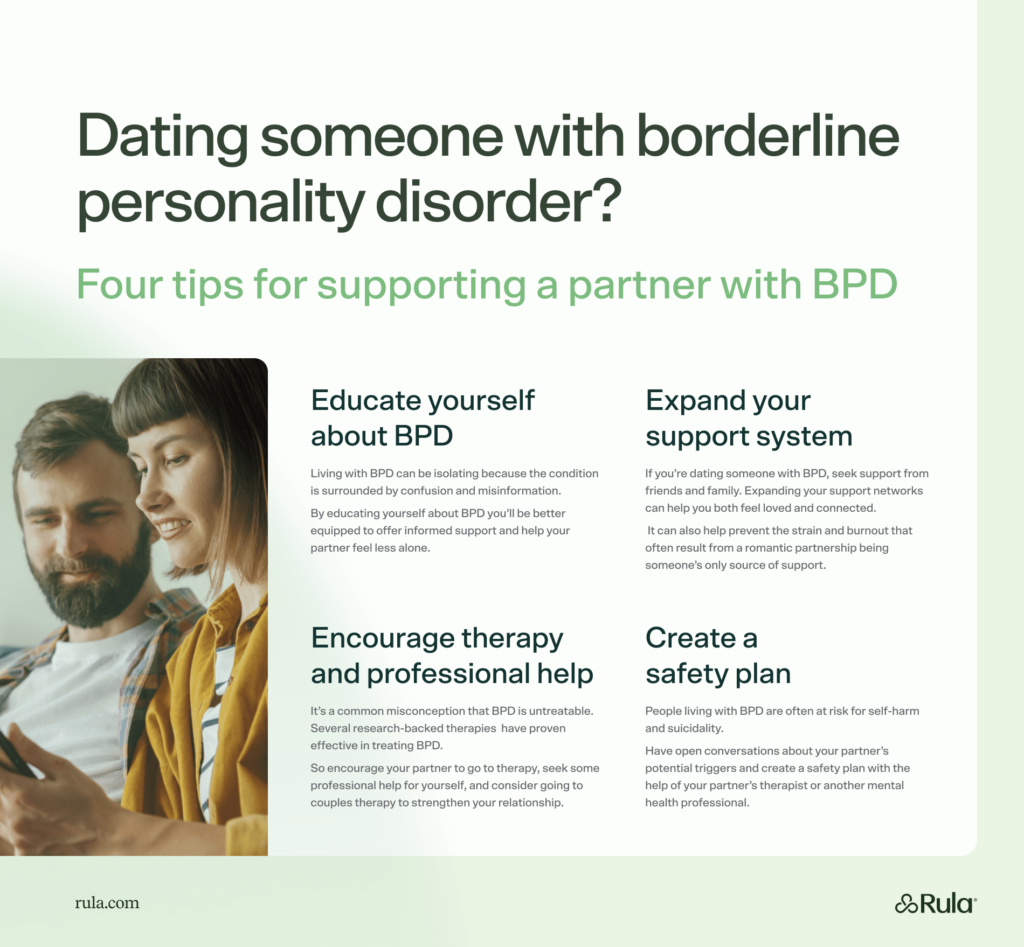
Tips for dating someone with BPD
Every person living with BPD will have their own unique experience of the condition. So in addition to the tips listed below, make sure to speak with them about the types of support they find most helpful.
Educate yourself about BPD: Living with BPD can be an isolating experience because the condition is surrounded by confusion and misinformation. By educating yourself about BPD you’ll be better equipped to offer informed support and help your partner feel less alone.
Expand your support system: If you’re dating someone with BPD, seek support from friends and family. Expanding your support networks can help you both feel loved and increase your sense of connection with others. It can also help prevent the strain and burnout that often result from a romantic partnership being someone’s only source of support.
Encourage therapy and professional help: There’s a prevailing misconception that BPD is untreatable, but that isn’t the case. There are several research-backed therapies that have proven effective in treating BPD. So encourage your partner to go to therapy, seek some professional help for yourself, and consider going to couples therapy to strengthen your relationship.
Create a safety plan: People living with BPD are often at risk for self-harm and suicidality. So it’s important to have an open conversation about your partner’s potential triggers and to create a safety plan with the help of your partner’s therapist or another mental health professional.
Dig deeper:
Dating someone with BPD can feel intense at times, but it can also be deeply meaningful. With understanding, boundaries, and support, healthy and loving relationships are possible.

Brandy Chalmers, LPC
Clinical reviewer
Find care with Rula
Dating someone with borderline personality disorder (BPD) can have its challenges, but it is possible to enjoy a meaningful and fulfilling relationship. If you’re feeling overwhelmed by your partner’s behaviors, it may be worth learning more about their condition or seeking additional support. Through individual or couples therapy, you can begin to set clear expectations, cultivate greater compassion, and strengthen your relationship.
At Rula, we’re here to help you feel better. Rula makes it easy to find a licensed therapist or psychiatric provider who takes your insurance. That way, you don’t have to choose between great care and a price you can afford.
Rula patients pay about $15 per session with insurance, and 93% say they feel better after getting care through Rula. We have 21,000+ providers, and appointments are available as soon as tomorrow. We’re here to help you take the next step — wherever you are in your mental health journey.
Trauma and PTSD therapists near you
New York, NY – Houston, TX – Rancho Cucamonga, CA – Austin, TX – Chicago, IL – Los Angeles, CA – Columbus, OH – Portland, OR – Dallas, TX – Jacksonville, FL – Charlotte, NC – Denver, CO – Huntsville, AL – Philadelphia, PA – Seattle, WA – Find your city

Liz Talago
Liz Talago, M.ed. is a mental health professional turned content writer and strategist based in the Detroit metro area. As an independent consultant for mental health organizations, Liz creates meaningful connections between brands and their audiences through strategic storytelling. Liz is known for championing diverse perspectives within the mental health industry and translating bold ideas into inspiring, affirming digital experiences.
In her free time, you can find her hiking with her two German Shepherds, puttering around her dahlia garden, or spending time with her family.

Nick Frye, MS, LCPC
Nick Frye, MS, LCPC holds a Master’s degree in Counseling Psychology from Loyola University Maryland and is a Licensed Clinical Professional Counselor (LCPC) in Maryland. With experience as a substance use disorder counselor and a private practice therapist, he has worked with diverse populations, specializing in depression, anxiety, life transitions, and grief. Passionate about mental health, Nick transitioned from direct patient care to education and mentorship to support both early-career and seasoned professionals in their growth and development as clinicians.
Rula’s editorial process
Rula’s editorial team is on a mission to make science-backed mental health insights accessible and practical for every person seeking to better understand or improve mental wellness.
Members of Rula’s clinical leadership team and other expert providers contribute to all published content, offering guidance on themes and insights based on their firsthand experience in the field. Every piece of content is thoroughly reviewed by a clinician before publishing.