

Rula has facilitated more than 10 million therapy and psychiatry sessions to date, expanding fast, affordable access to mental healthcare across the U.S.
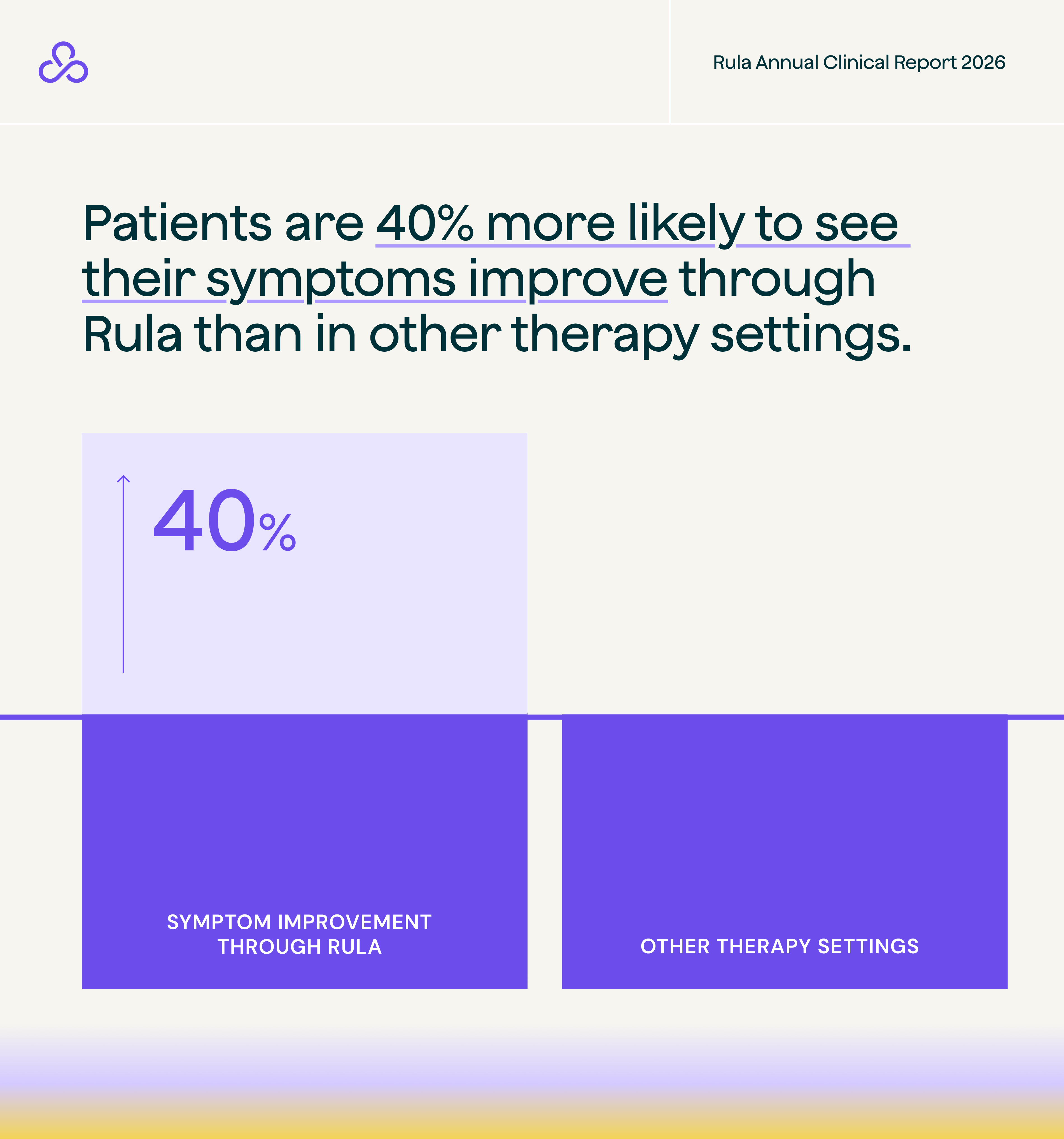
Patients are 40% more likely to see their symptoms improve through Rula than in other therapy settings.
Seventy-one percent of Rula patients reach meaningful improvement within three months.
Our year by the numbers
Mental healthcare works better when quality is measurable, outcomes are transparent, and care continuously evolves. This was the inspiration behind our first-ever Annual Clinical Report.
Inside, we’re sharing a behind-the-scenes look at the clinical systems, data, and care models that help patients improve faster — and that help us continuously raise the standard of care. Explore the full report as we share industry findings and celebrate some major milestones along the way.
“This report is organized around what we believe makes Rula different: how we provide access, how we collect data, how we manage quality, and what that produces for patients. We're publishing this because we believe the mental healthcare system deserves more transparency, not less — and because we're genuinely excited about what becomes possible when you build care around data, accountability, and continuous improvement.”
—Doug Newton, M.D., MPH, chief medical officer, Rula Health
Rula has facilitated more than 10 million therapy and psychiatry sessions to date, giving us the data and expertise to continually improve patient care and outcomes.
The 2026 report reveals the following key indicators of our clinical success:
Patients receiving care through Rula show clinically meaningful improvement at rates approximately 40% higher than certain published mental health benchmarks.
Patients get help quickly with nationwide, next-day access to in-network mental healthcare and a median wait time of just one day.
Seventy-one percent of patients with moderate-to-severe symptoms show clinically meaningful improvement within eight weeks, as measured by validated clinical instruments like the PHQ-9, the GAD-7, and the Rula Wellbeing Scale.
Ninety-eight percent of patients report making progress on the issues that brought them to Rula.
A system built on quality
Our clinical quality system is built around four pillars that reinforce each other: our standard of care, outcomes flywheel, a high-quality network of providers, and intersession support. This self-reinforcing approach helps us exceed industry benchmarks while improving year after year.
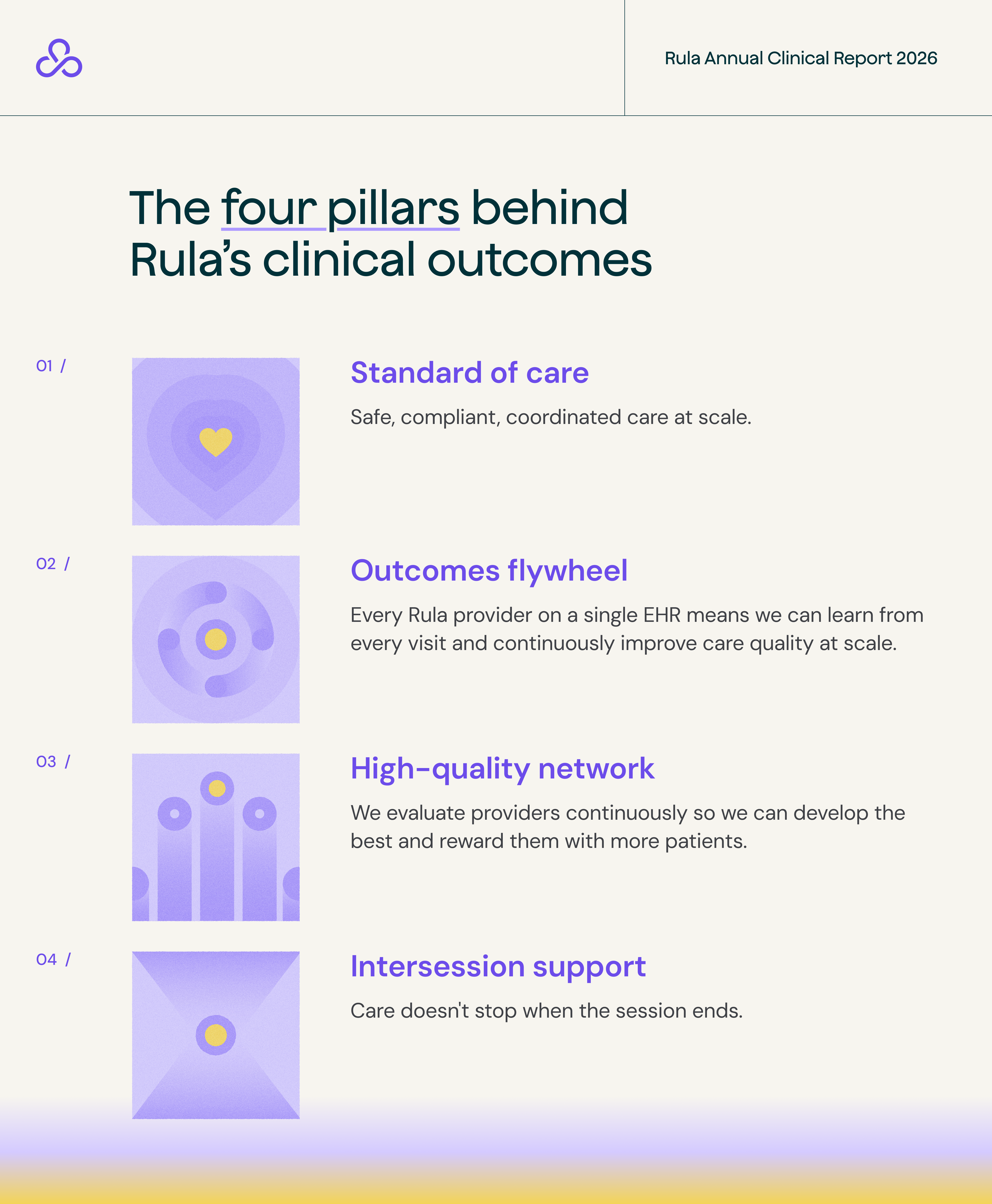
Standard of care: Compliant, coordinated care at scale is the foundation that everything else — access, affordability, patient safety, documentation, and care coordination across more than 23,000 providers — rests on.
Outcomes flywheel: Having every Rula provider on a single electronic health record (EHR) means we can learn from every visit and continuously improve care quality at scale. We measure what matters, understand through data what drives improvement, and double down on what works.
High-quality network: We continuously assess provider performance to provide targeted support, recognize clinical excellence, and maintain a network designed to deliver high-quality mental health care.
Intersession support: Caring and compassion don’t stop when sessions end, as we believe that the next frontier of behavioral health is continuity. We envision this as building pathways, like self-service tools, that extend support between visits and meet patients where they are in their mental health journey.
Improving access at every step
In a time when high financial stress can impact access to mental healthcare, we’re doubling down on connecting patients with quality, affordable care.
Rula’s approach combines fast appointment access with a broad network of diverse providers, expansive insurance coverage, and virtual and in-person sessions.
Network: More than 23,000 therapists and psychiatric providers treating 92 conditions across 83 therapeutic approaches
Coverage: Robust care for 124 commercial insurance plans, plus Medicare, Medicaid, and employee assistance programs
Cost: Affordable sessions at an average of just $15/session with insurance
Speed: More than 112,000 open appointments every week, with an average wait time of just one day
Expansion: Psychiatric services for patients in all 50 states since 2025, including expanded in-person therapy, extensive Medicare, Medicaid, and EAP coverage
Patient outcomes
Tracking patient outcomes helps hold both Rula and our providers accountable for delivering effective care. So we’re proud to report that data confirms that patients are 40% more likely to see their symptoms improve through Rula than in other therapy settings. And while measurement-informed care completion often falls below 20% in routine outpatient practices, Rula is proud to report that 78% of our patient visits include at least one completed measure.
Prioritizing data
Rula care is grounded in data — not just intuition. Our patients complete clinical assessments to continuously track symptoms, functioning, and progress toward goals. Industry-leading tools like the PHQ-9 for depression, the GAD-7 for anxiety, and the Rula Wellbeing Scale™ for functioning and quality of life are all used to track symptoms, functioning, and progress toward patient goals.
Research highlights
In 2025, Rula published three peer-reviewed studies in journals: INQUIRY, JMIR, and JMIR Pediatrics and Parenting.
These studies highlighted performance metrics like:
Ninety-eight percent of patients report making progress on the issues that brought them to Rula.
Nine out of ten patients say they would return to Rula if they needed mental healthcare again.
Ninety-three percent of patients report a strong therapeutic alliance with their provider. This is the single strongest predictor of positive treatment outcomes.
For more about Rula’s ongoing research and patient outcomes, check out the full report.
New technology in mental healthcare
AI tools
As artificial intelligence (AI) expands what’s possible in healthcare, we’re focused on using it thoughtfully to solve practical problems while minimizing potential risks.
For Rula, this looks like rolling out Rula Recap — an AI notetaking tool that helps reduce clinical documentation by around 63%. By automating part of the documentation process, it helps decrease administrative burden while leaving clinical decision-making to providers.
And this is just the first step. Our team continues to look for ways to leverage AI to improve experiences for both patients and clinicians.
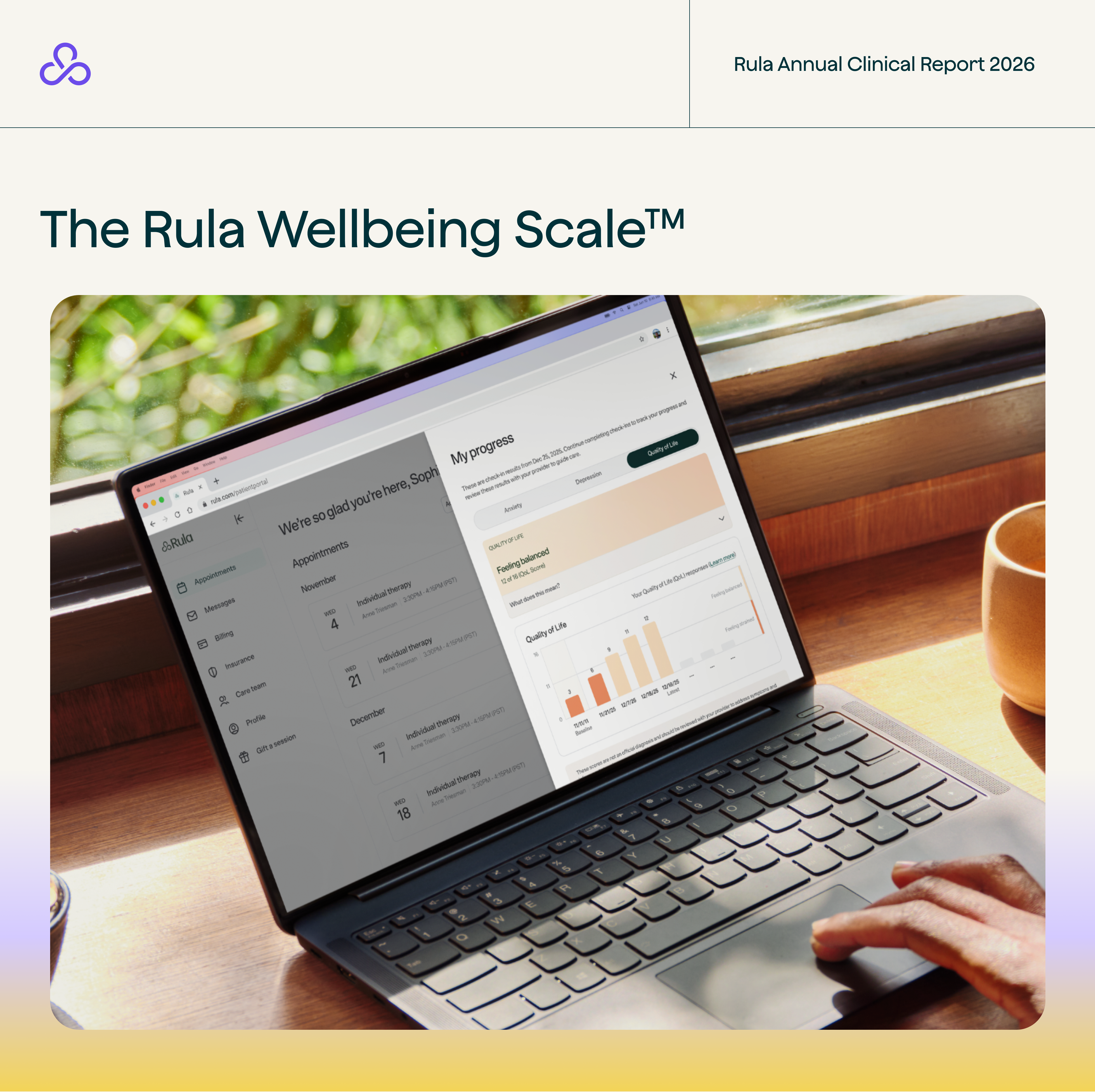
Introducing: The Rula Wellbeing Scale
Existing symptom scales, like the PHQ-9 (for depression) and the GAD-7 (for anxiety), can paint an incomplete picture of a patient’s mental health and overall well-being. So we built something new to help capture the parts of mental health that symptom checklists can miss..
We started by surveying clinicians to understand what was missing with current symptom scales – important information like work performance, relationships, and daily capacity. Then we used those insights to shape the scale and test it across thousands of patients. The resulting Rula Wellbeing Scale helps us to measure whether someone is truly feeling and functioning better. When administered alongside the PHQ-9 and GAD-7, this assessment helps clinicians explore the underlying factors contributing to depression and anxiety – an important step in improving patient outcomes.
From my experience, measurement-informed care doesn’t make therapy feel more rigid. Rather, it helps me see more clearly what is working and where a client may still be struggling. Reviewing that data together often deepens trust because clients can see that we’re making treatment decisions based on their progress, not just guesswork.

Brandy Chalmers, LPC
Clinical reviewer
Find care with Rula
Our clinical team is committed to building on findings from our first-ever annual report. As we continue to make our mark on the standard of care in behavioral health, we’ll keep publishing data and sharing insights to strengthen the mental healthcare industry, supporting providers and patients alike.
At Rula, we’re here to help you feel better. Rula makes it easy to find a licensed therapist or psychiatric provider who takes your insurance. That way, you don’t have to choose between great care and a price you can afford.
Rula patients pay about $15 per session with insurance, and 93% say they feel better after getting care through Rula. We have 21,000+ providers, and appointments are available as soon as tomorrow. We’re here to help you take the next step — wherever you are in your mental health journey.

Sarah Menz
Sarah Menz is a content marketing manager at Rula. She's also a sustainability expert and horticulture practitioner specializing in climate-resilient gardening and water-wise growing practices. She holds a master’s degree in sustainability and has over a decade of experience working at the intersection of climate, water, and the home gardening industry.
Based in Denver, Sarah is a Master Gardener with hands-on expertise in plant care, soil health, and adapting growing practices to a changing climate. Her work explores how environmental change shapes everyday life, including the emotional and psychological impacts of climate stress, and how practices like gardening can support resilience and well-being.
Her insights have been featured in publications including Homes & Gardens, Real Homes, and The Spruce, where she covers sustainable gardening, water management, and climate-conscious living.

Brandy Chalmers, LPC
Having faced challenges like childhood abuse, neglect, and the loss of her father to suicide, Brandy Chalmers is deeply passionate about providing compassionate care. She is a Licensed Professional Counselor, Nationally Certified Counselor, and Registered Play Therapist with a Master’s Degree in Clinical Counseling and Marriage and Family Therapy.
Brandy also teaches at a university, sharing her expertise with future mental health professionals. With over a decade of experience in settings like inpatient care and private practice, she specializes in helping clients with perfectionism, trauma, personality disorders, eating disorders, and life changes.
Rula’s editorial process
Rula’s editorial team is on a mission to make science-backed mental health insights accessible and practical for every person seeking to better understand or improve mental wellness.
Members of Rula’s clinical leadership team and other expert providers contribute to all published content, offering guidance on themes and insights based on their firsthand experience in the field. Every piece of content is thoroughly reviewed by a clinician before publishing.