

Most people are familiar with the term “narcissism.” But you may not know that it comes in a variety of forms.
All forms of narcissism involve grandiose thinking, inflated self-importance, and an intense fear of rejection. But people living with covert narcissism turn these symptoms inward. This makes covert narcissism harder to detect.
Covert narcissism is not an officially recognized mental health condition. But some of the treatments for narcissistic personality disorder may be helpful for people living with covert narcissism.
The term “narcissism” is one of those clinical mental health terms that’s made its way into everyday conversation in recent years. But it’s important to note that a person can exhibit traits of narcissism without meeting the diagnostic criteria for narcissistic personality disorder.
Most people understand a “narcissist” as someone with an inflated ego and a lack of empathy. This description is often associated with overt, or classic narcissism, which tends to be more outwardly noticeable. But this definition only represents a part of the narcissism spectrum. There’s a less obvious form of narcissism that can be subtler and more challenging to detect. It’s called covert narcissism, which may involve insecurity, hypersensitivity to criticism, and less obvious expressions of narcissistic traits. Learning more about it can help you identify it in yourself or others.
Find your match
Take the first step toward better mental health.
Identifying traits of covert narcissism
Unlike more traditional presentations, covert narcissism can be harder to recognize. People with covert narcissism may:
Appear shy, withdrawn, or insecure
Have low self-esteem while still feeling a deep sense of self-importance
Be highly sensitive to criticism or rejection
Crave attention, validation, and admiration from others
Experience challenges with empathy and prioritizing other people’s needs
Have difficulty maintaining healthy relationships
Engage in passive-aggressive behaviors instead of openly expressing anger
Frequently compare themselves to others or experience feelings of envy
People with covert narcissism may not show the outward dominance or aggression often associated with overt narcissism. Their behaviors are usually more subtle and can be easier to miss.
Some people may also withdraw from social situations because they’re afraid of negative feedback or criticism. Some research suggests social media may worsen these fears by creating more opportunities for comparison, validation-seeking, and exposure to other people’s opinions.
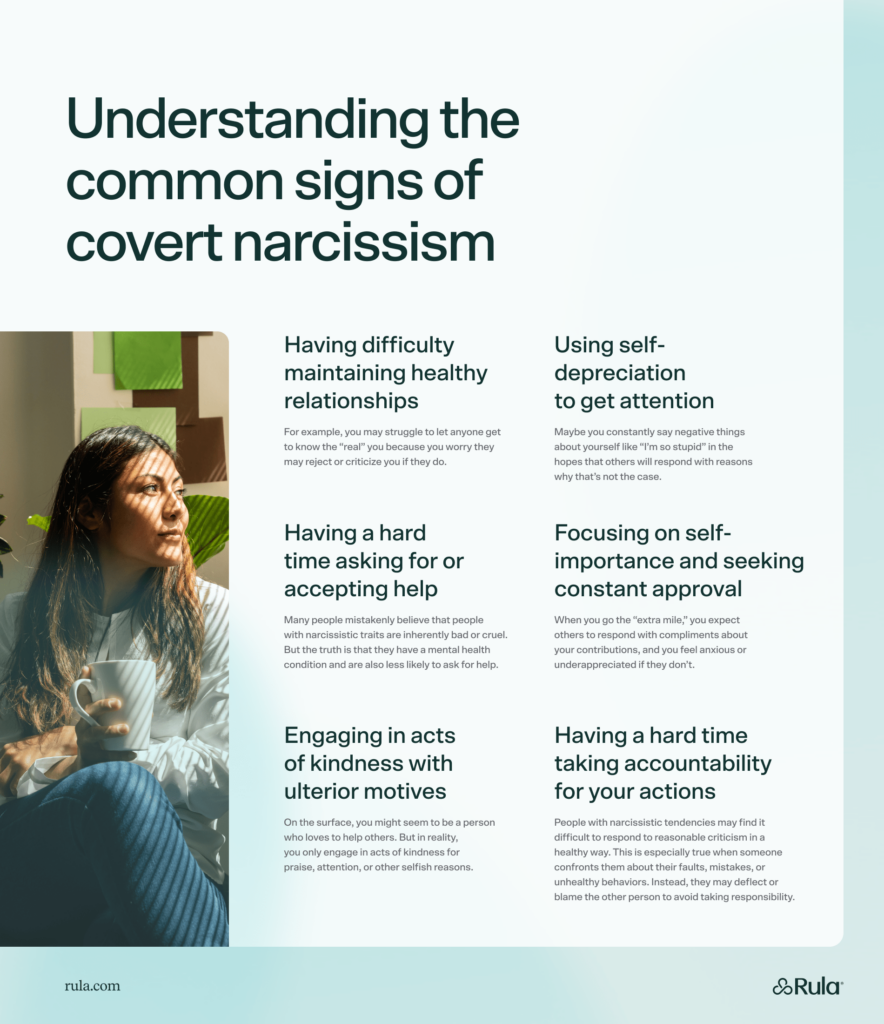
Signs and symptoms of covert narcissism
Covert narcissism can be harder to detect than other forms of narcissism. While they may be subtle, some common signs and symptoms include:
Having difficulty maintaining healthy relationships: For example, you may struggle to let anyone get to know the “real” you because you worry they may reject or criticize you if they do.
Using self-depreciation to get attention: Maybe you constantly say negative things about yourself like “I’m so stupid” in the hopes that others will respond with reasons why that’s not the case.
Having a hard time asking for or accepting help: Many people mistakenly believe that people with narcissistic traits are inherently bad or cruel. But the truth is that they have a mental health condition and are also less likely to ask for help.
Focusing on self-importance and seeking constant approval: When you go the “extra mile,” you expect others to respond with compliments about your contributions, and you feel anxious or underappreciated if they don’t.
Engaging in acts of kindness with ulterior motives: On the surface, you might be a person who loves to help others. But in reality, you only engage in acts of kindness for praise, attention, or other selfish reasons.
Having a hard time taking accountability for your actions: People with narcissistic tendencies may find it difficult to respond to reasonable criticism in a healthy way. This is especially true when someone confronts them about their faults, mistakes, or unhealthy behaviors. Instead, they may deflect or blame the other person to avoid taking responsibility.
Dig deeper:
What is the difference between covert and overt narcissists?
The main difference between overt and covert narcissists is an internal versus external presentation of symptoms. A covert narcissist turns their symptoms inward, and that’s what makes the condition harder to detect. On the other hand, an overt narcissist will behave in ways that make their sense of superiority and other symptoms obvious.
While both overt and covert narcissists can demonstrate any of the symptoms of narcissistic personality disorder listed below, only the overt narcissist will demonstrate them publicly.
Inflating their talents and achievements (grandiosity)
Fixating on fantasies of gaining more power, success, beauty, etc.
Adhering to the belief that they are exceptional and can only be understood or accepted by other exceptional people
Constantly seeking affirmation and admiration from others
Demonstrating entitlement and a belief that they deserve to be treated better than others
Manipulating or taking advantage of others for personal gain
Having an inability to demonstrate empathy or concern for others’ needs or feelings
Frequently behaving in cruel or arrogant ways without remorse
Believing that others are envious of them or often feeling envious of others
What causes covert narcissism?
Covert narcissism is not an officially recognized and diagnosable mental health condition. Rather, it’s a common presentation of narcissistic personality disorder. Because it’s an unofficial presentation, there’s not a lot of research on covert narcissism specifically. However, according to the research that does exist, there are some childhood experiences that may make you more likely to develop narcissistic personality disorder.
These include:
Being a survivor of abuse or neglect
Experiencing trauma
Having parents who were excessively judgmental
Having parents that gave you constant, excessive praise
Other factors that may contribute to narcissistic personality disorder include having a close relative who also experiences narcissism or having certain neurobiological traits.
Some people also wonder whether covert narcissism is related to borderline personality disorder (BPD). While they’re separate conditions, they can share overlapping traits like sensitivity to rejection and relationship difficulties. A mental health professional can help determine what’s contributing to these behaviors because different conditions can look similar on the surface.
Impacts of covert narcissism in relationships
Covert narcissism can affect many different types of relationships. While the behaviors may be subtle, they can still create confusion, hurt feelings, and conflict over time.
Covert narcissism can affect different relationships including:
Romantic relationships: A person may need constant reassurance while having difficulty meeting their partner’s emotional needs. They may become defensive when receiving feedback or withdraw when they feel criticized.
Parent-child relationships: Parents with covert narcissistic traits may place their emotional needs ahead of their child’s. Some children may grow up feeling responsible for managing their parent’s emotions or seeking their approval.
Friendships: Friendships may feel one-sided. A person may expect support from others but have difficulty offering the same level of support in return.
Workplace relationships: Covert narcissism can create tension among coworkers. Someone may experience challenges with feedback, feel overlooked, or become resentful when they don’t receive recognition.
Can people with covert narcissism change?
Yes — change is possible — but it often requires self-awareness, motivation, and a willingness to accept help. This can be difficult because many people with narcissistic traits don’t recognize that their behaviors are contributing to problems in their relationships.
Still, change can happen over time. People who engage in treatment and remain committed to personal growth may learn healthier ways to communicate, respond to criticism, build empathy, and maintain stronger relationships. Progress is often gradual, and setbacks can happen along the way.
How is covert narcissism treated?
Many people with narcissism resist treatment. This is due to an inability to see their thoughts or behavior as unhealthy. In addition, research shows that more than half of people with narcissistic personality disorder do not follow their treatment plans. This leads to fewer positive outcomes for this population.
However, people living with covert narcissism may benefit from some of the treatments used for narcissistic personality disorder, including:
Therapy: Attending individual, group, or couples therapy can help you interrupt unhelpful patterns, learn new coping skills, and practice healthy ways of relating to others. It can also help you improve your self-esteem, understand your emotions, and discover new ways of responding to stressful situations.
Medication: There aren’t currently medications that can treat narcissism. However, many people living with narcissistic personality disorder also have other co-occurring mental health conditions, like depression. Treating symptoms of other conditions can help improve your symptoms overall.
Committing to care: Living with covert narcissism can leave you feeling like therapy might not be worth your time. But it’s important to try to keep an open mind, attend your sessions consistently, and stay focused on your goals for treatment.
If you or someone you care about is experiencing domestic violence, you can call the National Domestic Violence Hotline at 800-799-7233 or text 88788 to the same number.
The care you need, when you need it
Learn how Rula can support your mental health journey
People often focus on whether someone is a ‘narcissist’, but a better question is whether the relationship feels healthy. If you regularly feel dismissed, manipulated, or like your needs don’t matter, those patterns deserve attention, regardless of the label.

Brandy Chalmers, LPC
Clinical reviewer
Find care with Rula
Covert narcissism can be hard to detect and even harder to treat. However, working with a mental health professional can help you address issues like fear of rejection and the need for attention and praise. If you think that you or someone you know is living with symptoms of covert narcissism, know that support is available.
At Rula, we’re here to help you feel better. Rula makes it easy to find a licensed therapist or psychiatric provider who takes your insurance. That way, you don’t have to choose between great care and a price you can afford.
Rula patients pay about $15 per session with insurance, and 93% say they feel better after getting care through Rula. We have 21,000+ providers, and appointments are available as soon as tomorrow. We’re here to help you take the next step — wherever you are in your mental health journey.

Liz Talago
Liz Talago, M.ed. is a mental health professional turned content writer and strategist based in the Detroit metro area. As an independent consultant for mental health organizations, Liz creates meaningful connections between brands and their audiences through strategic storytelling. Liz is known for championing diverse perspectives within the mental health industry and translating bold ideas into inspiring, affirming digital experiences.
In her free time, you can find her hiking with her two German Shepherds, puttering around her dahlia garden, or spending time with her family.

Lolly Coleman, MS, LMFT
Lolly Coleman, LMFT, has 15 years of experience in the mental health field. She is a practicing therapist and has operated her own private practice for the past nine years. Lolly has clinical experience with numerous populations and has specific specialty in anxiety, depression, self-harm, geriatrics including dementia, and autism.
Lolly's passion for the field is personally fueled, wanting to create a better system for the people she loves. In her free time she enjoys leisurely time at coffee shops and exploring nature with her family.
Rula’s editorial process
Rula’s editorial team is on a mission to make science-backed mental health insights accessible and practical for every person seeking to better understand or improve mental wellness.
Members of Rula’s clinical leadership team and other expert providers contribute to all published content, offering guidance on themes and insights based on their firsthand experience in the field. Every piece of content is thoroughly reviewed by a clinician before publishing.